Math & Comp Sci: Graph theory: what is a cut set?
The tutor defines cut set with a couple of examples.
When one imagines a cut set, one imagines removing edges from a graph, but not the vertices they connect.
In this context, we are thinking of undirected graphs.
A cut set is the minimum number of edges whose removal will disconnect a given portion of the graph. Each cut set is specific to a portion of the graph to be disconnected.
Consider the graph below:
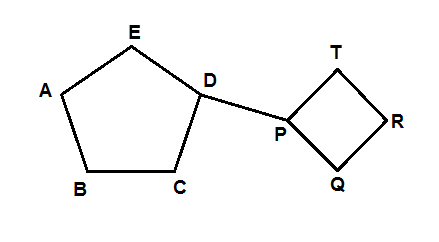
To disconnect just the vertex A from the graph, edges AB and AE need to be removed. The corresponding cut set is {AE, AB}. This may also be written {{A,E},{A,B}}, meaning “[the set containing] the edge from A to E or E to A, and the edge from A to B or B to A”.
{DP}, or {{D,P}}, is also a cut set: removing the edge DP separates the two cyclic portions of the graph.
When we disconnect one part of a graph from the rest, we say the number of components of the graph has increased by 1. A graph’s number of components is its number of isolated parts. Before any cut sets are applied, a connected graph (such as the one above) has 1 component: κ(graph)=1. A component, within itself, can be called a connected component.
HTH:)
Source:
Grimaldi, Ralph P. Discrete and Combinatorial Mathematics. Don Mills: Addison-
Wesley, 1994.
Jack of Oracle Tutoring by Jack and Diane, Campbell River, BC.
Leave a Reply
You must be logged in to post a comment.