Math: Partial Factoring
Tutoring math, you notice a new technique now and then. The math tutor shares one he recently heard about.
I first heard of partial factoring over ten years ago. Two students were discussing it. Since neither asked me about it, I never found out what they meant. The event recurred every few years.
Partial factoring was never taught to me in school, but I finally got a look at it the other day in someone’s textbook. It’s a really nice method for finding the vertex of a parabola. Here’s how it goes:
Example: Find the vertex, axis of symmetry, max or min value, domain, and range of y=-2x2 + 6x + 14
Solution: We see that
y=14 whenever -2x^2 + 6x=0
To find the two x-coordinates where y=14, we solve
-2x^2+6x=0
using the common factor technique:
-2x(x-3)=0
which implies that
-2x=0 or x-3=0
and finally
x=0 or x=3
Therefore, y=14 when x=0 or when x=3.
Knowing the shape of a parabola (which y=-2x2 + 6x + 14 is), we can draw a rough sketch.
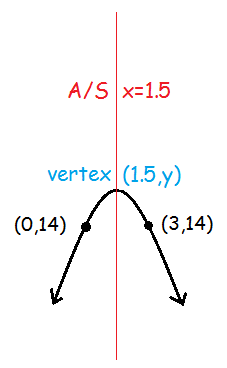
Note the vertex is at the top because the lead coefficient (-2, in this case) is negative. The vertex will be midway between the two x values where y is 14: x=0 and x=3. Getting the average of those two values, we arrive at 1.5, which means that the vertex will be at (1.5, y). To find the y value of the vertex, we put 1.5 for x into the equation:
y=-2(1.5)^2+6(1.5)+14
y=18.5
Therefore, we have (1.5,18.5) as our vertex.
The A/S, which means “axis of symmetry”, is the vertical line x=1.5, as shown in red. The graph’s maximum value is the y coordinate of the vertex: 18.5. The range must therefore be y≤18.5, since the graph goes down from there. The domain is all real numbers; it always is for quadratic equations, of which y=-2x2+6x+14 is one.
Partial factoring makes finding the vertex of a quadratic function very easy. I’m sure you’ll agree:)
Source: Nelson Foundations of Mathematics 11.
Jack of Oracle Tutoring by Jack and Diane, Campbell River, BC.