Math: short division
Tutoring math, short division is rarely the aim – yet, it’s often a means. The math tutor introduces it.
I used short division back in my May 4, 2013 post about finding square roots and cube roots. I didn’t explain the process then, though I did show it. Now, I’ll give an explanation.
Short division is great, especially for one-digit division. Here’s an example:
Calculate 70101÷3.
Solution: To use short division, you’ll likely rewrite the question as
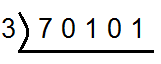
Now, proceed as follows:
Start by asking yourself, like you would with long division, how many times 3 goes into 7. It goes in twice with one left over. Write the 2 below the 7. Then, put the 1 behind the 7 like so:
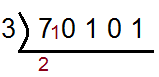
Now, the 1 with the zero behind it makes a “10”. Ask yourself how many times 3 goes into 10. It goes three times, with 1 left over. Write the 3 below the zero of the 10. Write the 1 in front of the next number, also (in this case) a 1:
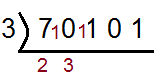
Now, ask yourself how many times 3 goes into 11. It’s three times, with 2 left over. Write the 3 under the ones digit of the 11; write the 2 in front of the next number, the second 0.
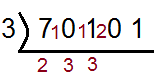
We imagine now that the 2 with the zero behind it forms 20. We ask how many times 3 goes into 20? The answer is 6 times, with 2 left over. We write the 6 under the 0, the 2 in front of the next number, which is the 1:
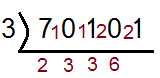
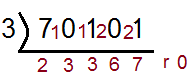
Finally, we ask how many times 3 goes into 21. The answer is 7, with 0 left over. We write the 7 below the 1. Since there are no more numbers left, the remainder is 0:
Observations:
1) It definitely helps to use a different color to work the question from the one it’s written in.
2) Short division might be less prone to errors than long, because there is so much less to write down.
There are still a couple more points to mention about short division. We’ll visit them in a future post:)
Jack of Oracle Tutoring by Jack and Diane, Campbell River, BC.