Adding Vectors: The “chart thing”
Especially when tutoring physics 12, vector addition comes up. Let’s use the “chart thing”:
I took Physics 12 in 1988. In that class, we added vectors component-wise. However, at university they used sine law and cosine law. I haven’t seen someone use component-wise addition in over twenty years – until this week. Now, they call it “the chart thing:)”
Let’s imagine we’re adding the following two vectors:
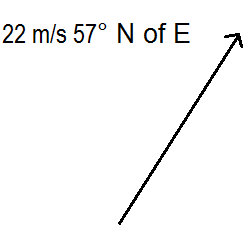
Well, first we use trig to resolve each into horizontal (x) and vertical (y) components:


Now, looking above, we see that for the first vector, the x component is pointing left: it’s negative. A downward component would be negative as well, but we don’t have any downward components in this problem.
Now, to the chart:
| vector | x component | y component |
| vector 1 | -12.3 | 8.60 |
| vector 2 | 12.0 | 18.5 |
| total: result vector | -0.3 | 27.1 |
You just add downwards to get the total x and y components of the resultant vector. We see that the result has -0.3 for its x component and 27.1 for its y component. We can build it as follows:
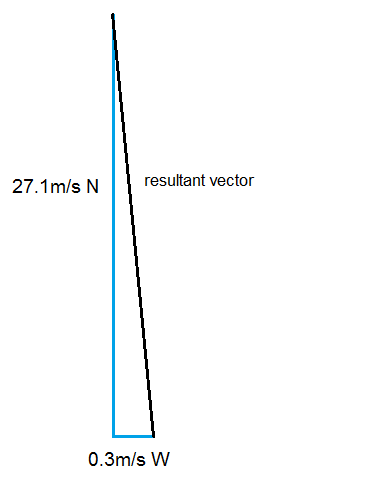
Now, use a² + b² = c² to get the hypotenuse. Of course, you’ll still get 27 (two sig digits), since 0.3 is too small to have any significant effect on the vertical component of 27.1. Use 2ndtan(27.1/0.3) – you may also know it as arctan(27.1/0.3) – to get the angle of 89°.
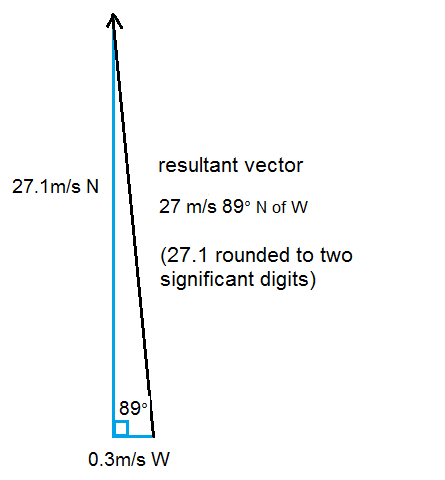
Since there were only two significant digits in the original problem, we should give the answer with two. (This isn’t always true, technically, but it’s a good rule of thumb.) Hence, we give the answer in two sig digs: 27 m/s 89° N of W.
Jack of Oracle Tutoring by Jack and Diane, Campbell River, BC.