Math: break-even point
Tutoring math, you realize that to most people, math’s main importance is its applications. The tutor presents a business example.
Any small business owner knows the break-even point is when you’ve paid your expenses, but haven’t “made” any money. At the break-even point, you haven’t lost or gained.
In math, you can notice the break-even point on a graph. (For a refresher in graphing, see my post here.) Consider the following example:
The Chess Club, in order to fund its overseas tournaments, holds a bake sale each year. The items at the sale cost $1.50 each. To rent the hall, the club pays $240. Find the break-even point.
Solution:
Let P=profit
Let n=number of baked goods sold
Then P=1.50n – 240
Notice, of course, that profit doesn’t mean income; rather, it means income less expenses. The only expense we are considering is the hall rental; the baked goods, we can assume, are donated.
At the break-even point, P=0.
Let’s look at a graph that models the situation. To make some points to plot, we choose a few values of n, then plug each into our equation P=1.50n-240 to get the corresponding values for P. For instance, let’s find P when n=100:
P=1.50(100) – 240
P=150-240
P=-90
Therefore, when n=100, P=-90. By repeating that process for various values of n we arrive at the following table:
| n (number of baked goods sold) | P (Profit) |
| 0 | -240 |
| 100 | -90 |
| 200 | 60 |
Each (n,P) from the table means a point on the graph. For instance, when n=100, P=-90; therefore, (100,-90) will be on our line. We plot the points from our table as follows:
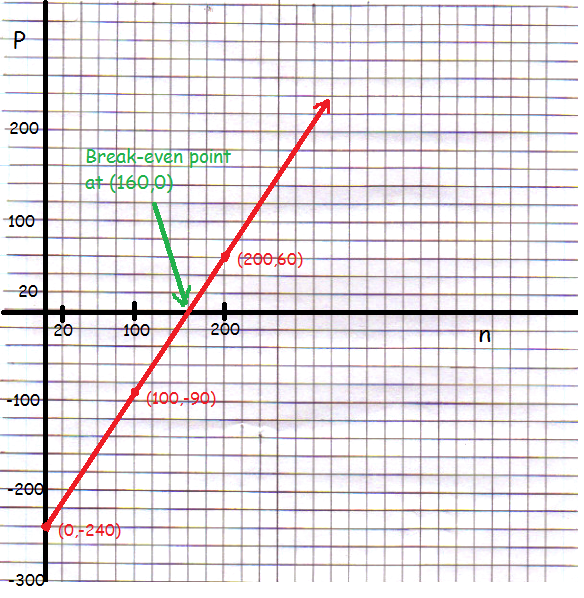
You can see the break-even point: it’s where our line cuts the horizontal axis. Note that, in this case, the x axis has been renamed the “n” axis; similarly, the y axis is called the “P” axis. In word problems, textbooks often rename the variables, calling them letters that stand for elements in the specific problem.
In our case, of course, the break-even point is 160; when 160 baked goods are sold, the expenses are paid. Any additional sales are profit.
You can also find the break-even point by setting P to 0:
0=1.50n – 240
Add 240 to both sides:
240=1.50n
Now, divide both sides by 1.50:
160=n
If desired, we could add (160,0) to our table of values.
Finding the break-even point can be a common question in math 10 and math 11. Its attractiveness is its real-world meaning:)
Jack of Oracle Tutoring by Jack and Diane, Campbell River, BC.