Math: Trigonometry: The Tangent Ratio
As a math tutor, you explain the tangent ratio a few times a year.
Trigonometry involves finding unknown sides and angles of triangles. At first, it only involves “right” triangles – that is, ones that contain a 90º angle.
At beginner’s level, there are three trigonometric functions: sin, cos, and tan. (Of course, tan is short for tangent.) Note their presence on any scientific calculator. By the way: in most cases, if a calculator has sin, cos, and tan keys, it’s probably got all you need for high school.
Understanding sin, cos, and tan means understanding how the sides of a triangle are named.
The hypotenuse is always the longest side.
The remaining two sides are called the legs. The leg touching the angle of interest is called the adjacent side; the other leg is the opposite.
Note that the following diagram, like most diagrams in trig, is not to scale.
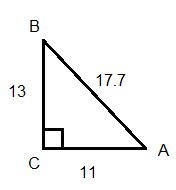
The capital letters refer to angles A, B, and C. If A is the angle of interest, then the adjacent side is 11, and the opposite is 13. If, on the other hand, B is the angle of interest, then the adjacent side is 13, while the opposite is 11.
The definition of tan is as follows:
tan=opposite/adjacent
Therefore, in the diagram above,
tanA=13/11
Here’s where we get practical: if you know the angle of interest, then your calculator knows its tan ratio. For instance, tan32º=0.625, rounded to three decimal places. (Make sure your calculator is set to degrees.)
Let’s use the tangent ratio (known affectionately as tan) to solve a height question:
Problem:
When the sun is at 40º elevation, a tree casts a shadow 13m long. How high is the tree?
Solution:
First, we draw a diagram:

Note that the box in the corner means 90º.
Looking at the diagram, we see that relative to the 40º angle, the height, h, is the opposite side. 13m is the adjacent side. Remembering that
tan=opposite/adjacent
it follows that, in our case,

Of course,
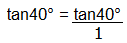
So then

Using the method of cross-multiplication described previously in this post, we proceed:
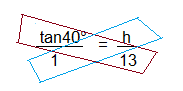
so that we have
h(1)=13(tan40º)
h=10.9m
Apparently the tree is 10.9m high.
Hope this gets you on the way to calculating those heights that seemed out of reach until now:)
Jack of Oracle Tutoring by Jack and Diane, Campbell River, BC.