Polarity: why ionic substances (salts) dissolve in water
The tutor briefly explains why water can dissolve so many salts.
A salt is a compound consisting of a metal plus a nonmetal. (You can see my post here for some background, as well as related posts in my chemistry category.) Essentially, a metal is a species that will assume a positive charge, while a nonmetal will assume a negative one.
An ionic compound can be called a salt, since what makes it ionic is that its nonmetal takes one or more electrons from its metal. Although the entire species is not charged, there is uneven distribution of charge inside.
Water has such a charge imbalance: the oxygen end has more than its share of electrons, since it essentially steals those of the hydrogens. Technically, the hydrogens’ electrons are “shared” between the oxygen and hydrogen, but the sharing is unequal: it’s 5:3 towards the oxygen end. The result is that the oxygen end carries a net negative charge, while the hydrogen end is correspondingly positive:
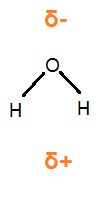
A molecule that has a positive end and a negative end can be described as polar: water is polar.
When an ionic compound – aka, a salt – is put in water, the opposite charges attract: the negative end of the water is attracted to the positive end of the salt, while the positive end of the water is drawn to the negative end of the salt. By this fashion, many water molecules surround each end of the salt. The salt gets drawn apart by the water molecules pulling from either end: the salt separates into ions. The attraction of the water molecules to the salt and its resulting ions is called solvation.
Not all ionic compounds are soluble in water. There are particular reasons why a given one may not be; I’ll explore some in future posts.
HTH:)
Sources:
Turner, Mason A. and Curtis T. Sears, Jr: Inquiries in Chemistry. Toronto: Allyn & Bacon Canada Ltd., 1977.
Jack of Oracle Tutoring by Jack and Diane, Campbell River, BC.