Organic Chemistry: sn1 reaction
The tutor describes a fundamental reaction of organic chemistry.
In yesterday’s post I explained the concept of solvation. While that post discussed solvation in the context of dissolving salts, solvation can also happen with organic species. In particular, you could suggest that solvation facilitates the organic sn1 reaction.
Sn1 refers to a substitution reaction in which the reactant has a target group that is eventually removed by attraction to the solvent. The target group is also referred to as the leaving group:
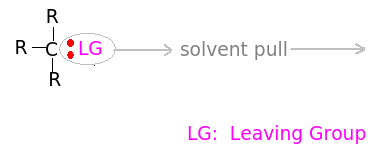
Once the leaving group is pulled away, a vacancy is left:
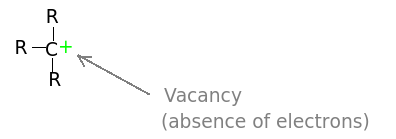
The vacancy is immediately filled by a replacement group, which can be a solvent molecule or some other species mixed with the solvent:
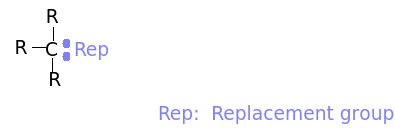
A condensed description of the sn1 reaction is that a replacement group is substituted in place of the leaving group.
With sn1, the rate determining step is the first one; ie, the removal of the leaving group.
I’ll be talking more about organic chemistry reactions in coming posts. HTH:)
Sources:
Solomons, T.W. Graham. Organic Chemistry, 4th Ed. Toronto: John Wiley & Sons, 1988.
Jack of Oracle Tutoring by Jack and Diane, Campbell River, BC.